Discovering the Mangrove Ecosystem of Rathgama Lake
November 28, 2024 · by AquaTrek
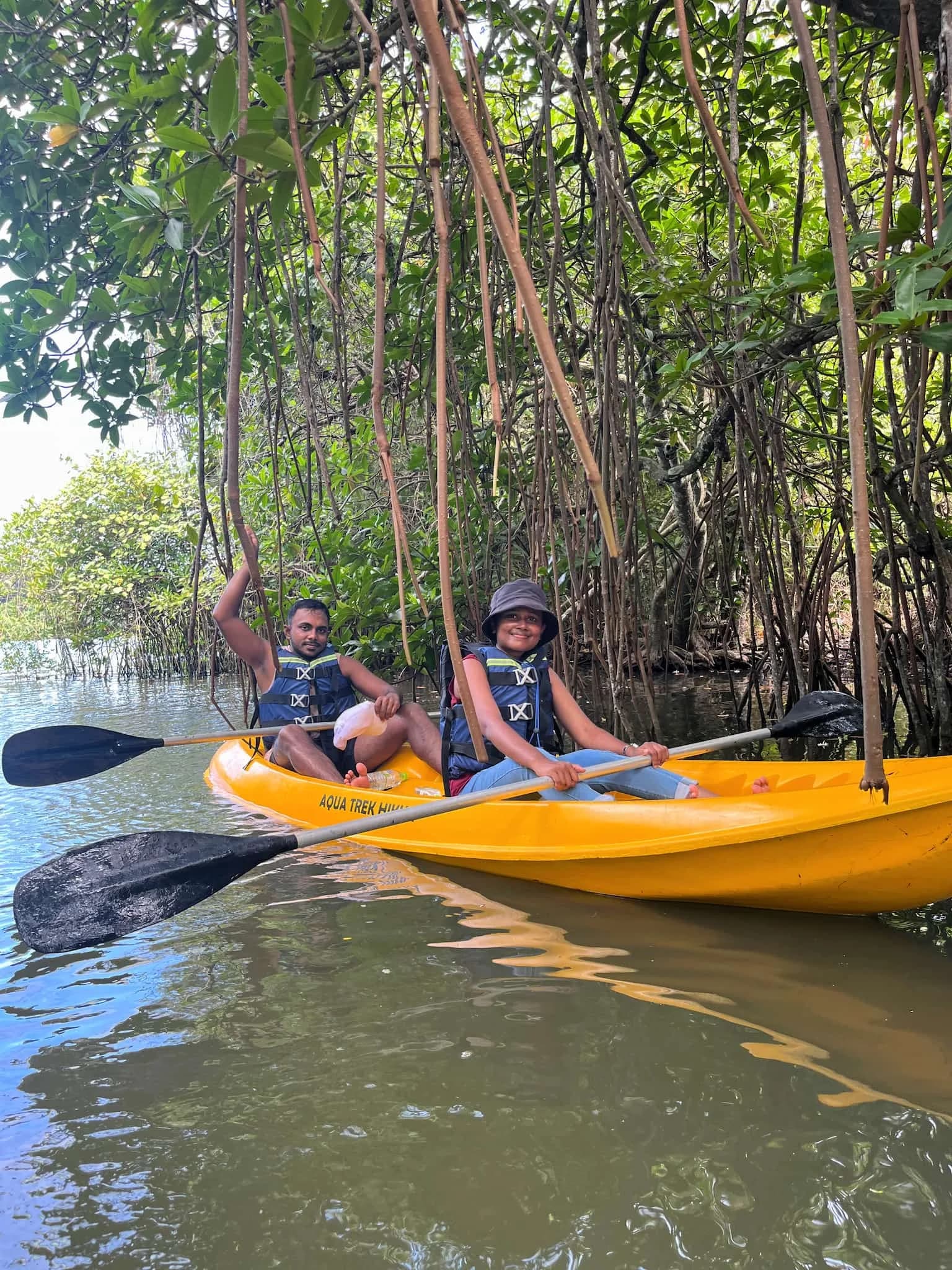
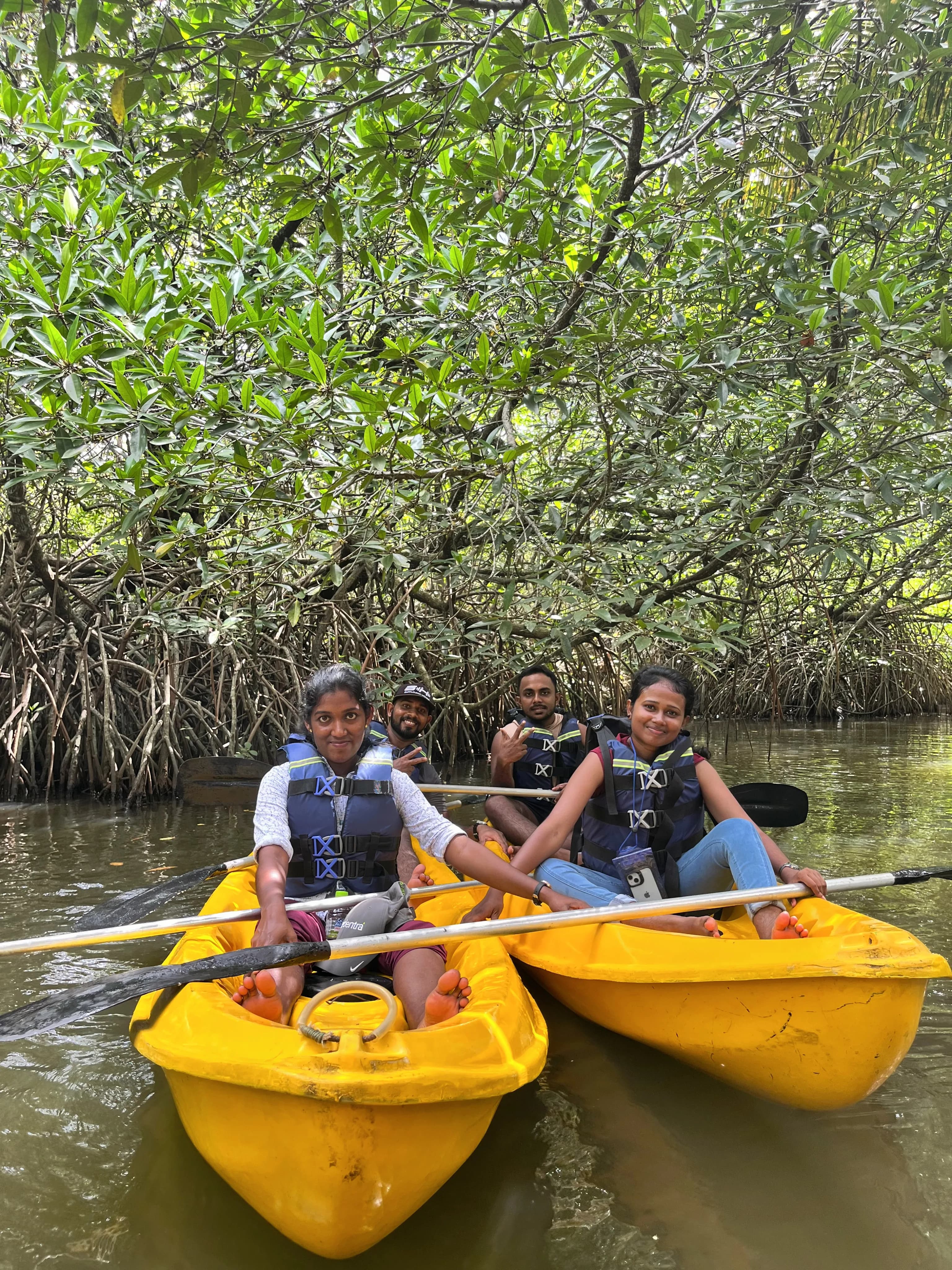
Most visitors to the Sri Lankan coast notice the coconut palms and miss what lies behind them. At Rathgama Lake, the real story begins at the tree line — in the dense, tangle-rooted fringe of mangroves that border the lake's channels and islands. This is one of southern Sri Lanka's most intact coastal mangrove systems, and paddling through it by kayak is like entering a living architecture that took millions of years to perfect.
What Are Mangroves, Exactly?
Mangroves are not a single species but a functional group: trees and shrubs from dozens of unrelated plant families that have independently evolved the ability to survive in saltwater-saturated, low-oxygen soils. The key challenge they face — and solve in ingenious ways — is getting oxygen to roots buried in anaerobic mud.
Sri Lanka has documented 24 true mangrove species, and the Rathgama system supports most of them. The lake's position at the Gin Ganga river mouth means it receives both freshwater from upstream and tidal salt intrusion from Hikkaduwa's reef-protected coastline. This gradient — from almost-freshwater at the northern end to near-marine at the southern outlet — creates distinct zones, each dominated by different species.
The Species You Paddle Past
Rhizophora apiculata and Rhizophora mucronata are the most visible trees in the outer tidal channels. Their branching prop roots arch from the trunk into the mud at a 45-degree angle, holding the tree upright in unstable substrate and collecting oxygen through lenticels (pores) on the root surface. Their leaves are thick and waxy — a strategy for managing salt — and their seeds germinate while still on the tree, producing a torpedo-shaped propagule that drops and anchors directly in the mud below. You will see these propagules hanging in clusters, sometimes 30 cm long, pointed ends down.
Avicennia marina (the grey mangrove) dominates the inner, higher-salinity zones. Instead of prop roots, it deploys thousands of finger-like pneumatophores — pencil-thin vertical shoots that poke up through the mud around the tree base, sometimes carpeting entire flats. The effect is startling: a grey-barked tree apparently standing in a field of thin stakes. Avicennia handles salt differently from Rhizophora — it secretes excess salt directly through its leaves, which often taste noticeably salty if you rub them.
Bruguiera gymnorhiza, the large-leafed orange mangrove, grows at slightly higher elevations where flooding is less frequent. It uses knee roots — looping, elbow-shaped structures that rise and fall from horizontal cable roots, maximising surface area for gas exchange. Its bark is distinctive: dark grey and roughly textured, often colonised by lichens.
Excoecaria agallocha — the milky mangrove — is common around the lake's drier fringes. Its white latex sap is intensely irritating to skin and eyes; historically, fishers used it to stun fish in tidal pools. The tree sheds its leaves annually (unusual among mangroves) and the fallen leaves continue to leach toxins, deterring competing vegetation.
Ceriops decandra and Lumnitzera racemosa occupy the back-mangrove zone where tidal flooding is infrequent. Lumnitzera often marks the transition to terrestrial vegetation. Both species have small, dense leaves and tend to be shrubby rather than tall.
Sonneratia caseolaris, the mangrove apple, grows in deeper-water channels and is identifiable by its large, apple-like fruit and long, erect pneumatophores. Fruit bats and hornbills visit at dusk to feed on the fruit.
The Nursery of the Sea
The phrase "nursery of the sea" is not metaphor — it is functional ecology. The complex three-dimensional structure of mangrove root systems creates precisely the sheltered, food-rich, predator-poor microhabitat that juvenile marine fish require during the most vulnerable weeks of their lives.
Mullet (Mugil cephalus and Liza macrolepis), threadfin bream, and several species of snapper spawn offshore or in the open lake and then push larvae into the mangrove channels. The young fish shelter among the roots, feeding on algae, detritus, and small invertebrates, and migrate back to the open water or coral reef systems as juveniles. Research across the Indo-Pacific has shown that reef fish abundance correlates strongly with the extent of adjacent mangrove habitat — remove the mangroves and the reef fish populations decline within years.
Rathgama's mangroves support a rich community of invertebrates that underpin this food web. Fiddler crabs (Uca species) are the most visible: the males' single oversized claw, waved in elaborate display, is one of the spectacles of a slow paddle through a mangrove flat. Mud crabs (Scylla serrata), prized for their size and flavour, burrow into soft substrates. Mudskippers (Boleophthalmus and Periophthalmus species) are amphibious gobies that haul themselves onto exposed roots on modified fins — watching one breathe air and stalk insects on land while technically a fish remains one of the stranger pleasures of mangrove kayaking.
Carbon Storage and Climate Significance
Mangroves store carbon at a rate that disproportionately outweighs their small global footprint. They account for less than 1% of tropical forest area but contribute an estimated 10–15% of coastal ocean carbon burial. The reason is the anaerobic mud: when mangrove leaf litter falls into waterlogged sediment, decomposition is extremely slow, and organic carbon accumulates over centuries rather than being released as CO₂.
The term for this is "blue carbon" — carbon stored in coastal and marine ecosystems. A single hectare of mature mangrove can store 1,000 tonnes of carbon or more in its sediment. Rathgama Lake's mangrove belt, though not large by Mekong or Amazon standards, represents an irreplaceable local carbon store that would take centuries to re-establish if cleared.
Coastline Protection
The 2004 Indian Ocean tsunami provided a grim natural experiment in the value of coastal vegetation. Communities in Sri Lanka and India that had intact mangrove belts in front of them suffered significantly less damage than exposed settlements — the dense root systems and trunks absorbed wave energy and reduced surge height. The Sri Lanka government subsequently designated many coastal mangrove zones for protection.
Rathgama Lake's mangroves provide ongoing protection against the smaller-scale but regular storm surges that accompany the southwest monsoon. They also prevent the bank erosion that would otherwise accelerate sedimentation in the lake — silting that would reduce depth, kill seagrass beds, and ultimately degrade the entire habitat.
How to Identify Species From a Kayak
You don't need a botany degree to appreciate what you're paddling through. These visual cues work at kayak speed:
Prop roots arching from the trunk into the water → Rhizophora species (the classic "stilt-root" mangrove)
Pencil-like sticks poking straight up from the mud flat around the tree → Avicennia marina (pneumatophores)
Looping, elbow-shaped root knees rising from horizontal roots → Bruguiera gymnorhiza
Pale grey bark with white latex if the bark is cut or damaged → Excoecaria agallocha (do not touch the sap)
Large apple-sized green fruit hanging from branches over deep channels → Sonneratia caseolaris
Our guides can point out each species as you paddle, and will stop in the channels where the root architecture is most intricate. The inner channels at the northern end of the lake — reached only by kayak, not motorboat — contain some of the oldest and most mature trees.
A System Under Pressure
Rathgama's mangroves are legally protected, but the pressures on them are real. Freshwater diversion upstream alters salinity gradients. Plastic waste accumulating among the roots reduces light to understory seedlings. Occasional illegal clearing for small-scale agriculture or construction continues at the margins. Sedimentation from upstream agricultural runoff is accelerating.
Awareness matters. Every visitor who paddles these channels, learns the species names, and understands what the system does is a small vote for its survival. The economic argument for conservation — tourism, fisheries, coastal protection — is increasingly being made in policy circles, but ultimately these ecosystems persist because people value them enough to protect them.